


Most museumgoers pass through the decorative arts gallery without paying much attention. Assuming the porcelains displayed are just pretty objects to look at, many don’t realize the fascinating history hidden beneath their surfaces.
“Porcelain is not just a quaint decorative art,” said Garth Johnson, the Everson’s Paul Phillips and Sharon Sullivan Curator of Ceramics.
Porcelain was once the ultimate symbol of power, driving royals to outbid each other, and even leading to kidnappings, royal decrees, and the kind of intrigue usually reserved for spy novels. Today, artists like Laurent Craste are using the same medium to deliver sharp political and historical critiques of disparities that remain.
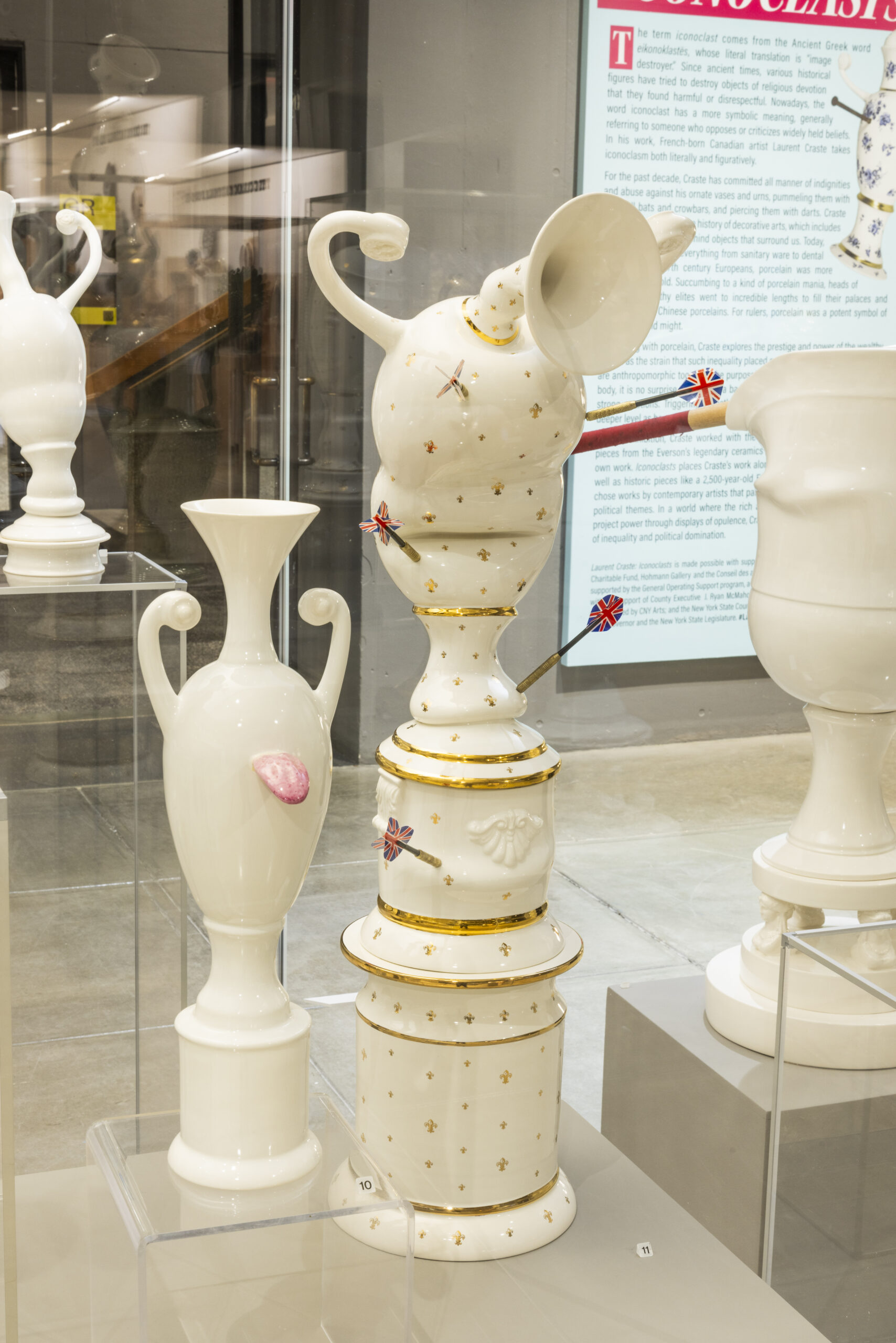
On view at the Everson Museum of Art through May 24, 2026, Laurent Craste: Iconoclasts features elaborate porcelain vases and urns by French-born Canadian ceramist Laurent Craste that prompt questions about class, money, and power.
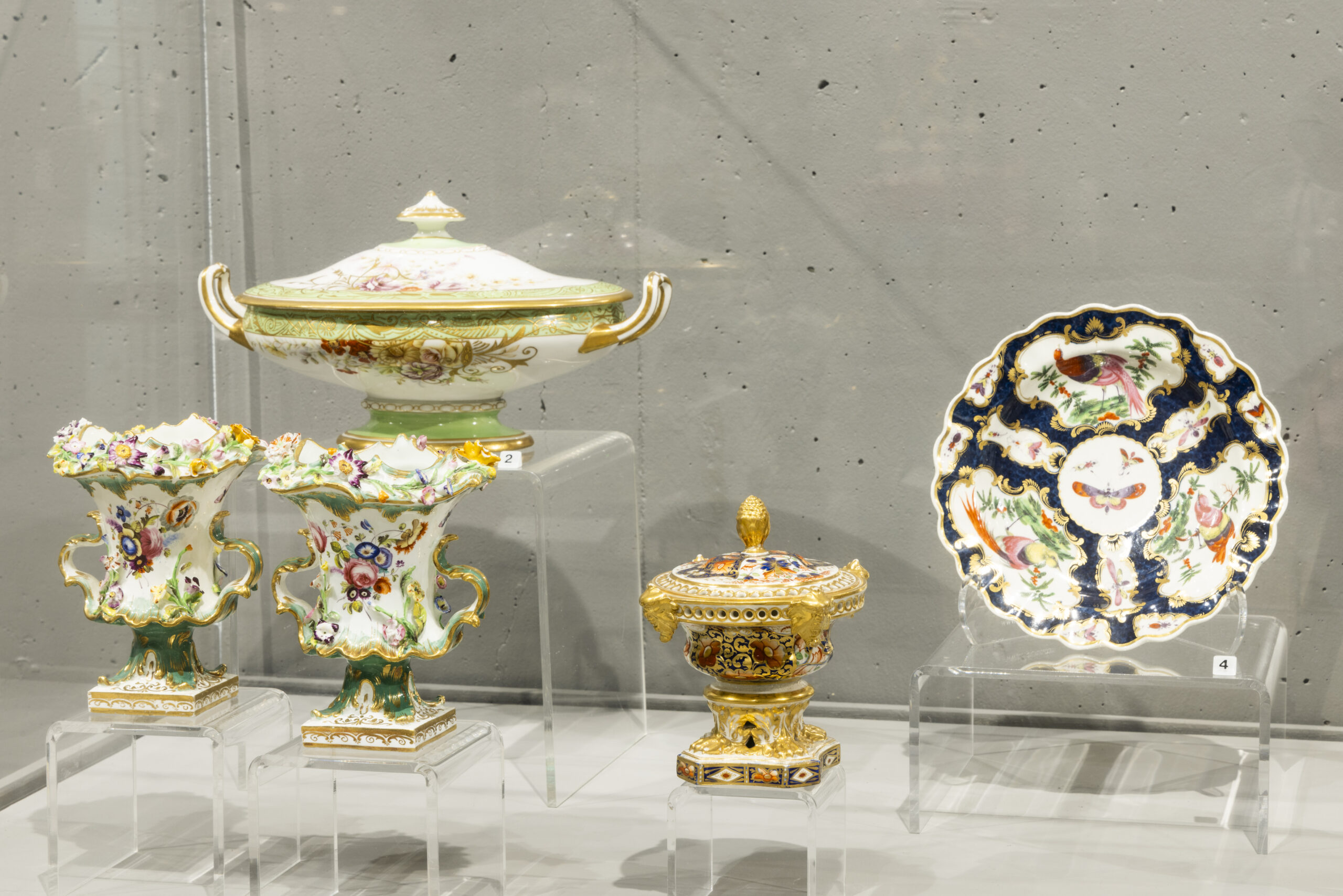
In Iconoclasts, Craste’s work is placed in conversation with roughly 50 historical and contemporary pieces from the Everson’s collection. Johnson said the Everson is showcasing some “major trophies” from its porcelain collection, many of which haven’t been displayed in years.
The selection includes one of the Museum’s most important historical collection pieces, a red-figured amphora from Southern Italy that dates to the late fifth century BCE. Greek and Roman ceramics inform the fundamentals of Western ceramics, with many key vessel shapes derived from them. “For me, it was really important to have these historical pieces,” Craste said. “But I also wanted to have artists who are critical, and who have a subversive approach.”
Viewers may also recognize prominent contemporary artists like Adrian Sachs, Kurt Weiser, and Leopold Foulem (the closest “ancestor” of Craste’s work, according to Johnson), who helped shape the ceramics field in the 1980s and 90s. “I think the accumulation and breadth of all these pieces are going to be a great takeaway from this show,” Johnson said.
Craste’s works are influenced by the long history of porcelain as an expression of luxury, especially among European aristocrats in the 18th and 19th centuries, when such wares represented taste and social status. “There was such a gap between the obsessions of the aristocracy and the reality of life for normal people,” Craste said.
His pieces mimic the elegant forms and decorative styles of aristocratic ceramics, yet they are reimagined through contemporary interventions that both reference and critique porcelain’s historical origins.
Many of Craste’s works are directly inspired by such aristocrats. Named after Marie Thérèse Louise of Savoy, a close confidant of Marie Antoinette who was assassinated in 1792, Craste’s baroque vase Princess de Lamballe appears to have been viciously torn and nailed to the wall. When asked what his works would say if they could speak directly to viewers, Craste responded on their behalf, asking: “Do I deserve this?”
The human-like qualities of Craste’s work — arms that seem almost clenched into fists, cartoonish mouths, and hunched posture — are intended to catch your attention humorously, thereby making the artwork’s subject more approachable. Craste hopes viewers feel empathy for the wounded vessels as they engage with his work.
“I don’t say that these people deserved to have been treated this way, but what they did with their fortune and their obsession with luxury to show their economic power is what led to a revolution,” Craste said.
When looking at these works, one might think that destroying the vase is part of Craste’s studio ritual. In actuality, the artist’s intervention process is carefully controlled. The vases are often not fully assembled when Craste meticulously pummels them with crowbars or pierces them with arrows. He then continues to hand-build elements of their bases. Craste compares his works to a staged crime scene or a simulation.
“I often joke that no harm was done to the vases,” Craste said. “The violence is suggested, but the actual gesture is not implemented when I work.”
However, it is true that at some stages of his work, Crase must choose to commit to a decisive intervention, such as tearing his works or using a baseball bat. These are the only interventions where the artist has no choice but to carry out a physical, violent act on the face of the vessel. Given the degree of risk, difficulty, and emotional vulnerability involved in the process, Craste has a strong attachment to these pieces, especially when they are created with a baseball bat.
“When the result is satisfying, I feel a relief,” Craste said. “It’s a very delicate moment in my studio — I become quite emotional.”
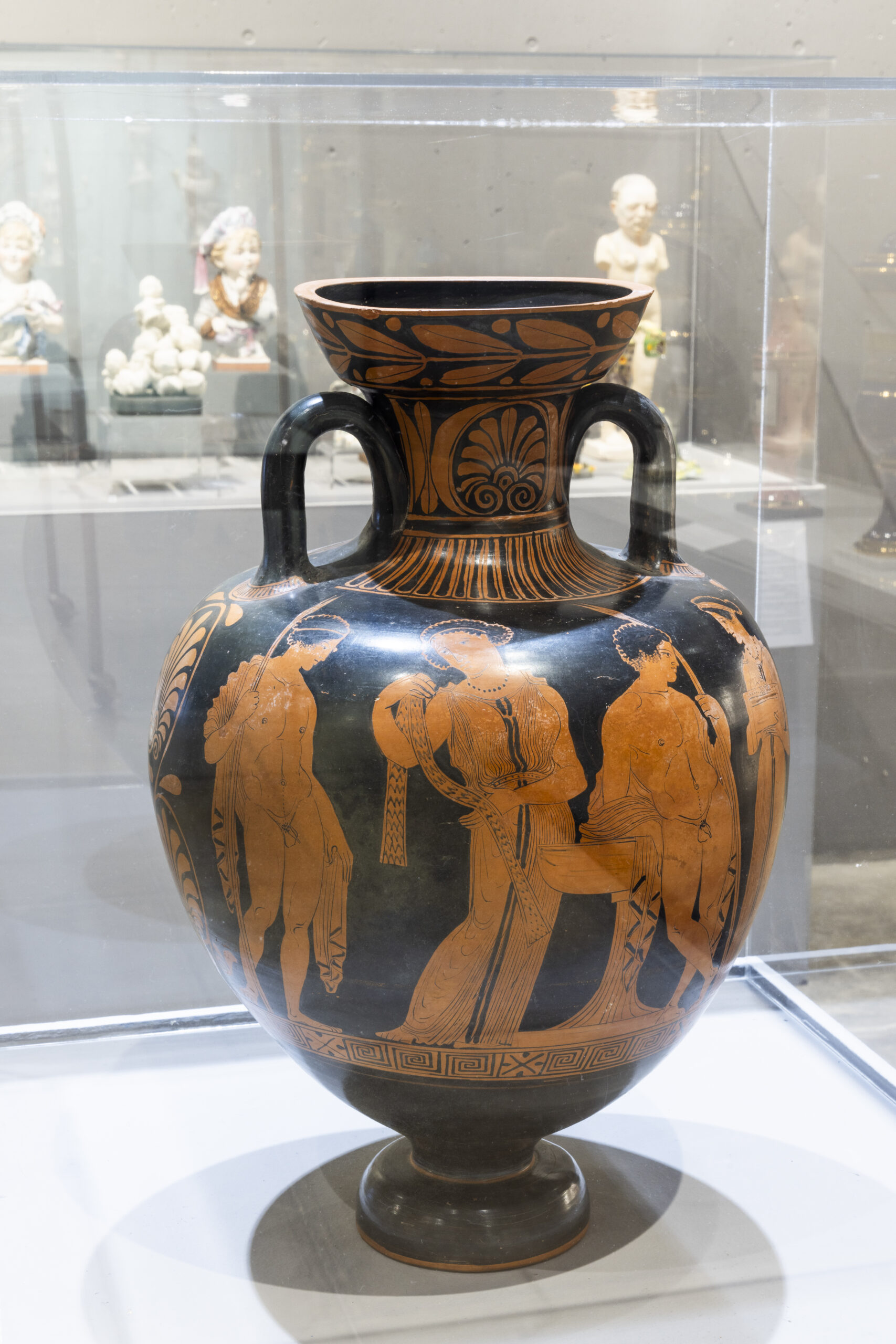
attributed to Arno Painter, Southern Italian
Neck Amphora of Panathenaic Shape, 500-450 BCE
Earthenware
21 x 7.625 in.
Gift of Mrs. Norton C. Nichols in memory of Mr. and Mrs. Robert E. Dietz
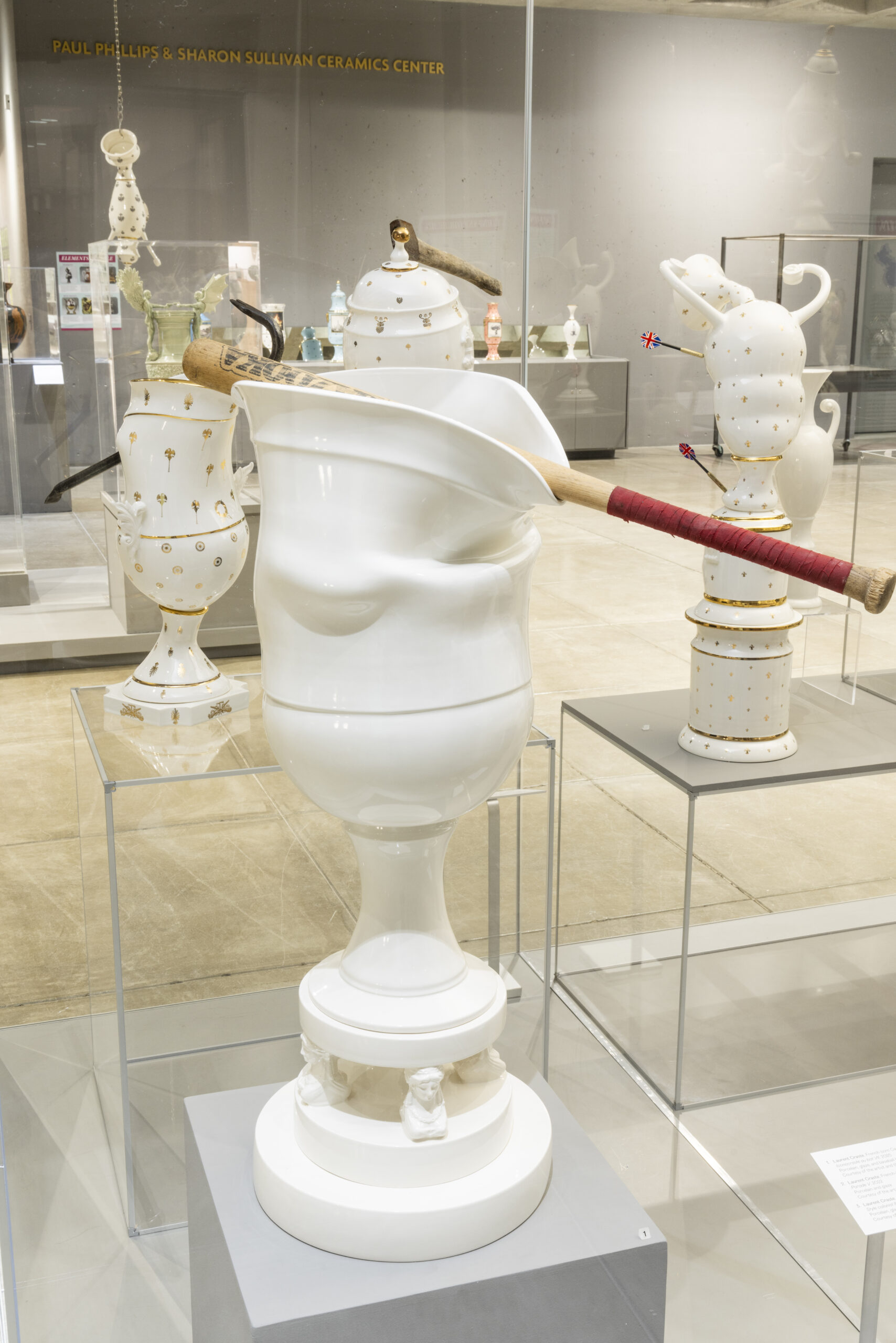
Laurent Craste
Iconocraste au bat VII, 2024/25
Porcelain, glaze, and baseball bat
40 3/4 × 33 5/16 × 14 ¾ inches
Courtesy of the artist
